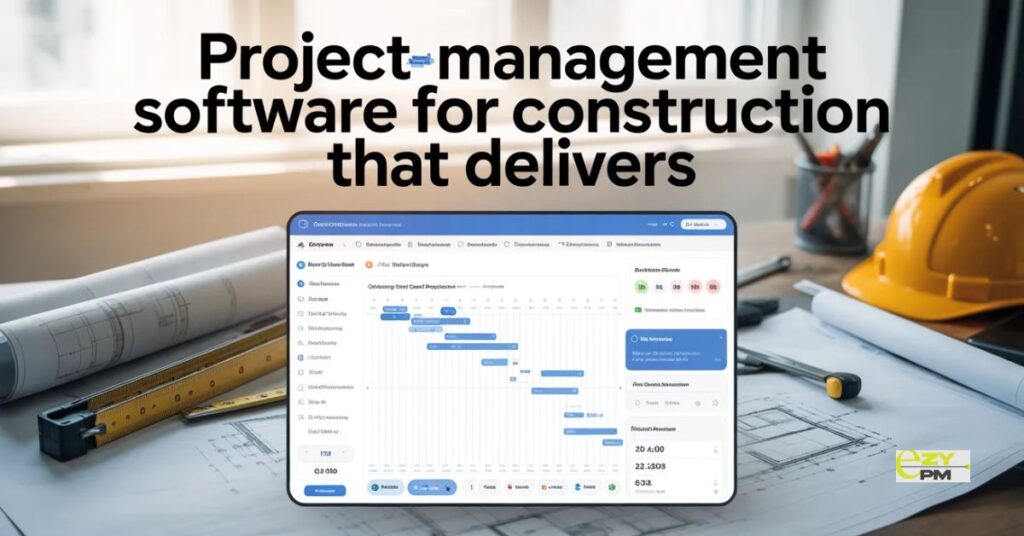
Project Management Software for Construction That Delivers
- Construction project management has more moving parts than most industries deal with. Trades working in sequence. Materials arriving on schedules that affect what can happen next. Subcontractors with their own priorities. Clients with expectations that were set at the start and do not always accommodate the reality of what happens during a build.
- Managing all of that through spreadsheets, phone calls and site visits works until it does not. The operation that handles two projects reasonably well on manual systems discovers its limits when it takes on four. The project manager who held everything together through experience and constant availability becomes the bottleneck rather than the solution.
- Project management software for construction is what allows a business to grow its project volume without its coordination problems growing at the same rate.
Why Generic Tools Fall Short
- The project management software market is large. Most of it was not built for construction.
- Tools designed for software development teams handle iterative work with flexible deadlines. Tools built for professional services manage client engagements and billable time. Tools designed for general business project coordination handle tasks and approvals reasonably well.
- Construction does not work like any of these. The dependencies are physical and strict. Concrete cures before formwork comes down. Structural steel goes up before cladding can start. Mechanical rough happens before ceilings get installed. These are not preferences. They are constraints imposed by physical reality and by the logical sequence of how a building comes together.
- A tool that does not understand these constraints produces schedules that look organized on paper and create problems on site. Project management software for construction built specifically for the industry understands sequencing at the level of detail that construction actually requires.
Visibility That Changes How Decisions Get Made
- The most immediate difference that proper construction project management software makes is visibility.
- Without it the project manager assembles a picture of what is happening from multiple sources. A call to the site supervisor. A message from a subcontractor. A spreadsheet that someone updated a few days ago. The picture that emerges is approximate and behind reality before it is even complete.
- Decisions made on approximate information produce approximate outcomes. A problem developing on site goes unnoticed until it has already affected other trades. A budget variance accumulates without anyone tracking it until the project is significantly over cost.
- Good project management software for construction puts current information in one place. Problems surface while there is still time to respond rather than after they have already escalated. The project manager is managing the project rather than spending the morning finding out what happened yesterday.
Budget Tracking That Keeps Pace
- Construction budget management done manually is always behind reality.
- The spreadsheet reflects what was entered last rather than what has actually been spent. Variations get logged late. Extra hours are absorbed without being recorded. Material substitutions create cost differences that nobody tracks until the project is already over budget.
- By the time a manual budget tracking process catches up with what has actually happened the spending has already occurred. The conversation with the client about cost overrun is happening after the fact rather than when there was still an opportunity to manage it.
- Construction project management software tracks costs as they occur. Every variation logged immediately against the relevant cost code. Every purchase visible against the estimate in real time. The financial picture is always current so decisions about spending get made with accurate information rather than outdated assumptions.
Subcontractor Coordination Without the Overhead
- Most construction projects involve more subcontractors than can be coordinated manually at the level of detail that prevents conflicts.
- Each trade has its own schedule and its own understanding of when it needs to be on site. Coordinating those individual schedules into a coherent project timeline requires constant communication when it is done manually. Every schedule change needs to reach every party it affects. Every dependency conflict needs to be identified and resolved by a person rather than surfaced by a system.
- Project management software for construction distributes that coordination load. Schedule changes flow through automatically to everyone affected. Dependencies are visible before they create conflicts rather than after they have already caused delays. Subcontractors see what they need to see without the project manager serving as the communication intermediary for every interaction between trades.
The Field Team Connection
- Construction project management software that works well in an office but fails on site is solving only half the problem.
- Progress updates that need to travel from site to office through a phone call or a site visit are already out of date when they arrive. Issues that get logged on site at the end of the day rather than when they appear are already historical by the time they surface.
- Mobile first design is what closes that gap. Site supervisors updating progress directly from a phone on an active site. Issues logged with photos at the location where they appear. Schedule access for subcontractors checking their programme without a call to the office.
- When the field team can engage with the system directly the information flowing through the project is current rather than a delayed summary of what happened before the last check in.
Growing Without the Chaos
- The construction businesses that scale successfully are not the ones that hire faster. They are the ones with systems that accommodate growth without coordination problems multiplying at the same rate as project volume.
- Taking on more work without proper systems means more things falling through the gaps. More coordination failures. More budget surprises. More difficult client conversations about delays that could have been managed if they had been visible earlier.
- Project management software for construction is the operational infrastructure that makes growth sustainable. The same coordination capability that works for two concurrent projects works for eight. The project manager who was the coordination bottleneck becomes a genuine manager because the system is handling the coordination overhead that used to consume their time.
- EZYPMP is a platform built for construction businesses at exactly that growth point. Practical project management tools that handle the coordination, visibility and budget control challenges of real construction projects without the enterprise complexity that puts the most capable platforms out of reach for businesses that are growing but not yet large.
Questions Worth Asking
How do we get subcontractors to engage with a new project management platform?
- Keep their interface as simple as possible. Schedule visibility and progress updates. Nothing more complex than they genuinely need. Simple experiences get used consistently. Complicated ones get avoided.
What is the best way to start if we have never used construction project management software before?
- Start with one active project. Get comfortable with the core functions before expanding to the full portfolio. A clean simple start builds confidence faster than a full implementation that overwhelms the team before they see the benefit.
How do we handle a project manager who is resistant to changing how they work?
- Let one project run through the system and show the results. When the time spent chasing information drops and problems surface earlier the resistance tends to resolve without much persuasion needed.