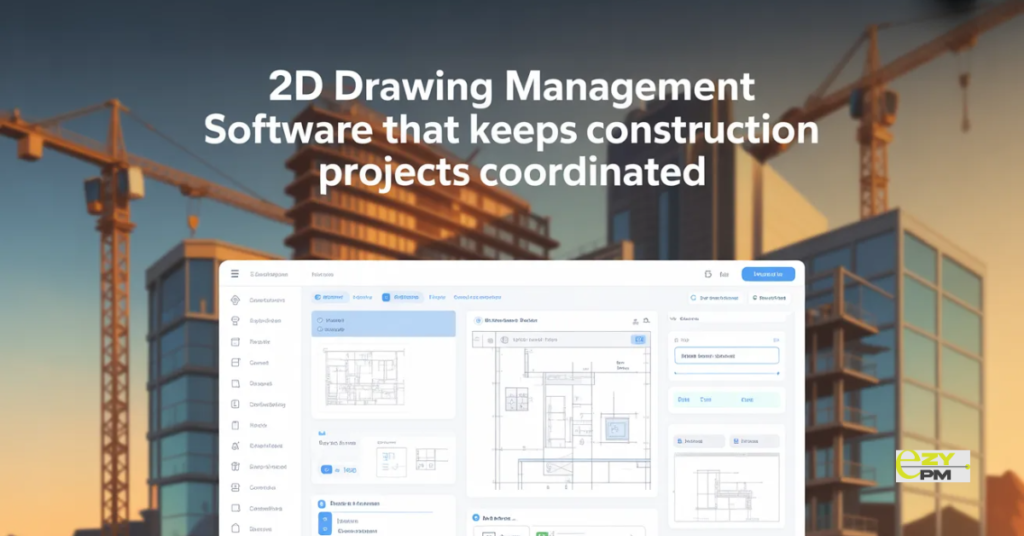
2D Drawing Management Software That Keeps Construction Projects Coordinated
- Construction projects have been built from two dimensional drawings for as long as construction has been a profession. Plans. Sections. Elevations. Details. The two dimensional representation of a three dimensional building that everyone involved in construction learns to read and work from.
- Despite the growth of three dimensional modeling and BIM the reality of most construction projects in 2026 is that two dimensional drawings remain the primary medium through which design intent is communicated to the people building the work. The site supervisor checking a detail on site is looking at a 2D drawing. The subcontractor setting out their work is working from 2D plans. The inspector verifying compliance is referencing 2D drawings against what was built.
- 2D drawing management software that serves these real world working conditions is what keeps construction projects coordinated at the level where most construction coordination actually happens.
Why 2D Drawing Management Remains Critical
- The persistence of two dimensional drawings as the primary construction communication medium is not simply inertia. It reflects genuine practical reasons why 2D remains the dominant format for most construction drawing communication.
- Accessibility. A 2D drawing in PDF format can be accessed by anyone with a phone. No specialist software required. No training in navigating a three dimensional model. No hardware requirements beyond the devices that everyone on a construction project already has. The universality of 2D drawing access across all parties on a construction project is a practical advantage that three dimensional models have not yet overcome for most construction communication.
- Clarity for specific purposes. A detailed drawing that shows exactly how a specific junction is to be constructed communicates that information with a clarity and precision that a three dimensional model view sometimes lacks. The exploded detail. The annotated section. The dimensioned plan. These two dimensional representations communicate specific construction information with a directness that three dimensional views sometimes obscure rather than clarify.
- Regulatory and contractual currency. Most building control submissions, planning applications and contractual document sets are still primarily two dimensional. The legal and regulatory framework of construction still operates primarily in two dimensions regardless of how the design was created.
- Familiarity across generations of construction professionals. The language of two dimensional drawing is understood instinctively by everyone who has worked in construction for more than a few years. Communication in a familiar medium is faster and less error prone than communication in a medium that requires translation.
- These practical reasons mean that 2D drawing management software addresses the primary coordination medium of most construction projects rather than a legacy format being phased out. Managing it well produces direct operational benefits.
What 2D Drawing Management Specifically Requires
- The management requirements for two dimensional construction drawings reflect the specific ways that 2D drawings are used and the specific risks that arise from managing them poorly.
- Version control that is absolute rather than advisory. The most dangerous situation in construction drawing management is not when a drawing is missing but when an outdated revision is being used as if it were current. A drawing that exists in two versions where both are accessible creates the conditions for the wrong one to be used. Two dimensional drawing management requires version control that makes the current revision unambiguously the one that is accessed and that makes previous revisions clearly historical rather than potentially current.
- The version control challenge in 2D drawing management is compounded by the ease with which 2D drawings can be copied, downloaded and saved locally. A PDF that was downloaded to a tablet last week and saved locally may not be the current revision if the drawing has been updated since the download. Management software that provides access to current drawings through a controlled environment rather than through local copies addresses this risk. The drawing accessed through the system is always current. The drawing saved locally last week may not be.
- Transmittal management that creates the formal record of drawing issues. The transmittal record shows what was issued to whom at what revision status and for what purpose. Construction Issue. For Information. For Comment. These transmittal purposes have contractual significance. A drawing issued For Comment has different status from one issued For Construction. The management software that handles transmittals as an integrated part of the issue process produces this record automatically rather than requiring a separate manual transmittal register.
- RFI management linked to the drawings the RFIs relate to. A request for information that arises from a drawing query should be linked to that drawing in the management system. The response that resolves the RFI should be visible alongside the drawing it relates to. This linkage connects the design development process to the document management in ways that make the project record coherent rather than a collection of disconnected documents.
- Field access that works in real construction site conditions. The drawing that a site supervisor needs to access should be accessible in under thirty seconds from a phone on site without reliable connectivity. This field access requirement shapes the mobile design of effective 2D drawing management software in ways that are different from the mobile access requirements of systems designed primarily for office use.
The Revision History That Matters Commercially
- The revision history of a two dimensional drawing set is more than an administrative record. It is the commercial evidence of design development that determines what each party knew at specific points in the project and what was built to which information at which time.
- Extension of time claims often turn on when design information is issued. A contractor who could not start an activity because the required drawing had not been issued needs the transmittal record to show when the drawing was actually issued. A contractor who built a drawing that was subsequently revised needs the revision history to show what the current drawing was when the work was carried out.
- Final account negotiations over variation claims require evidence of what was in the original scope and what was added by subsequent design changes. The drawing revision history that shows when each element was added to or changed in the design set provides that evidence when it is systematically maintained.
- The drawing management system that produces and preserves this revision history as a byproduct of how drawings are managed rather than as a separate record keeping activity provides the commercial foundation that construction businesses need without requiring dedicated effort to maintain it.
The Multi-Party Access Challenge
- Construction drawing management involves more parties than the design team and the principal contractor. Specialist subcontractors who need access to their relevant drawings. Suppliers whose fabrication work depends on current design information. Client representatives who need visibility of design development. Building inspectors who need access to approved drawings during inspections. Regulatory bodies during planning and building control processes.
- Each of these parties has different access requirements. The specialist subcontractor needs access to the drawings relevant to their scope without access to the full project drawing set. The building inspector needs access to approved drawings without access to drawings that are still in design development. The client representative needs visibility of design progress without access to commercially sensitive contractor information.
- 2D drawing management software with granular access control provides each party with exactly what they need. Not a binary all or nothing permission that either shares too much or restricts too much but role based access that reflects the project structure and the information requirements of each party’s role.
- The external party access also needs to be simple enough that parties who are not regular users of the system can access their relevant drawings without significant support. A subcontractor who needs to access their drawings and who encounters a complex login process or an unfamiliar interface before they can see the drawing they need will call the office instead. The office then becomes the intermediary for drawing access that the system was supposed to provide directly.
Integration With the Broader Project Record
- 2D drawing management software that integrates with the broader project management environment produces more coherent project management than drawing management that operates as an isolated function.
- Drawing revisions that flag their implications for the project programme. When a drawing is revised and the revision affects an activity that is currently in progress or about to start the project programme needs to be reviewed. Drawing management that connects to programme management surfaces this implication automatically rather than depending on the project manager to notice the revision and assess its programme implications.
- Drawing status connected to procurement. Material orders that were placed to the previous drawing revision need to be reviewed when a revision changes specifications or quantities. Drawing management that connects to the procurement process flags when a revision affects ordered materials rather than leaving this connection to be made manually.
- The complete project record. A project record that connects drawings to the RFIs they generated, the variations they informed and the programme activities they governed is more useful for commercial management and dispute resolution than a project record where each of these sits in a separate system without connection to the others.
- EZY PMP is a platform that brings two dimensional drawing management into the broader construction project management context. Connecting drawing control with project scheduling, work order management and commercial management so that the drawing set and the project record stay aligned throughout the project rather than diverging as revisions accumulate and connections between design changes and their operational implications go unmade.
Questions Worth Asking
How do we handle the version control risk when field teams download drawings to local devices?
- Control drawing access through the management system rather than through downloaded copies wherever possible. Mobile interfaces with offline capability that access drawings through the system even without connectivity are more reliable than downloaded copies for version control purposes. When local copies are unavoidable, establish clear protocols about when downloaded copies need to be verified against the current system version before use.
How do we manage drawing access for project parties who are not regular users of the system?
- Keep the external party experience as simple as possible. Accessing current drawings relevant to their scope and acknowledging receipt of revisions should take seconds rather than requiring navigation through an unfamiliar system. The simpler the experience for occasional users the more likely they are to use the system rather than calling the office.
How do we maintain the revision history in a form that is useful for commercial management rather than just as an administrative record?
- Ensure the transmittal records include the purpose of issue alongside the revision status and the parties to whom each revision was issued. Construction Issue versus For Information versus For Comment distinctions that are captured in the transmittal record provide the commercial evidence that matters when the revision history is needed to support a claim rather than just to track design development.