Top 5 Construction Project Management Software in Pakistan for 2026
- Pakistan’s construction industry is growing. Infrastructure projects. Housing developments. Commercial buildings. The sector is active and the pressure to deliver projects on time and within budget has never been higher. Yet the way most Pakistani construction businesses manage their projects has not kept pace with that growth.
- Spreadsheets. WhatsApp groups. Printed schedules pinned to a site office wall. Email chains for document distribution. These approaches work when the project is small and the team is tight. They stop working when projects get complex, teams get larger and multiple projects run simultaneously.
- Construction is still wrestling with paper-driven workflows and Excel spreadsheets. The main challenge is not lack of technology. It is adoption. A large number of construction firms cite lack of skilled staff as the biggest barrier to using project management tools.
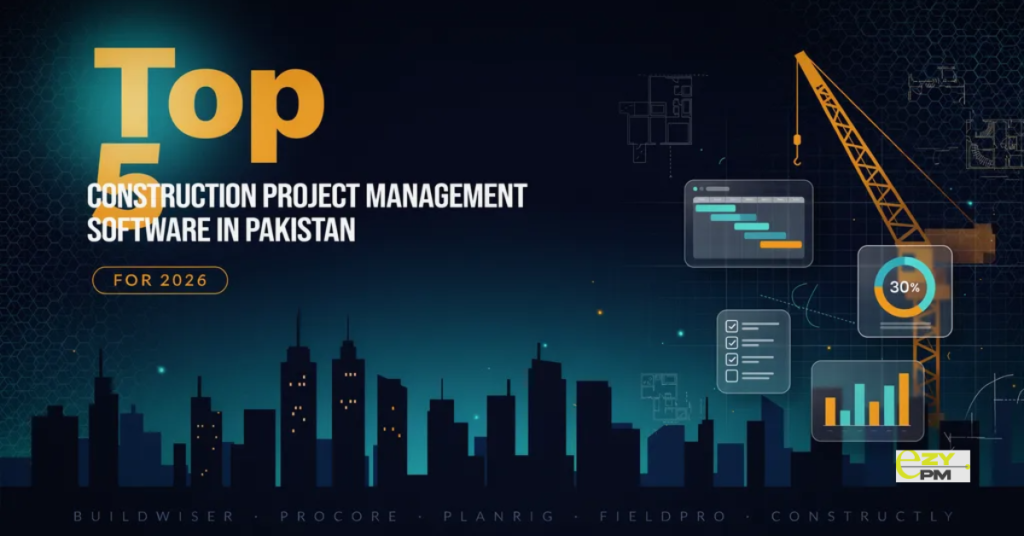
- That barrier is real in Pakistan as much as anywhere. But it is also being crossed by construction businesses that have found platforms accessible enough that their teams actually use them rather than reverting to old habits within weeks. This guide covers the top 5 construction project management software in Pakistan options worth knowing in 2026.
What Pakistani Construction Businesses Actually Need
- Before getting into specific platforms it is worth being clear about what construction project management software needs to do in the Pakistani context because the requirements are specific.
- Mobile access that works on the connectivity available across Pakistani sites. Not every construction site in Pakistan has reliable 4G. Platforms that work offline and sync when connectivity is available serve the actual conditions rather than ideal ones.
- Interfaces that do not require specialist training to use. Leaders hesitate to invest in software because teams may not adapt while teams remain under-skilled. Platforms that site supervisors and project managers can use after a brief orientation rather than weeks of training have a much higher chance of being adopted consistently.
- Document management that connects to the field. Field crews were frequently working off outdated blueprints because revised drawings sent via email were missed or not distributed to the entire team. On one project a team installed ductwork based on a three-week-old plan leading to a significant rework to accommodate a structural change. This story plays out on Pakistani construction sites regularly. Current drawing access from site eliminates it.
- Multi-project visibility for businesses managing several concurrent projects across different cities or sites. The contractor running projects in Lahore, Islamabad and Karachi simultaneously needs to see the status of all of them without flying between sites every week.
- Cost management that reflects how Pakistani construction projects are actually financed and managed. Budget tracking alongside programme tracking. Variation management that keeps the financial position current rather than discovering overruns at project completion.
Procore
- Procore is one of the most widely recognised names in construction project management globally. Procore leads for enterprise projects and consistently ranks among the highest rated construction project management solutions.
- The breadth of what Procore covers is genuine. Project management. Financial management. Quality and safety. Document control. Field management. The integration between these functions is real rather than nominal. A variation instructed in the project management module appears in the financial tracking automatically. A drawing revision issued through document control notifies the relevant parties.
- For large Pakistani contractors working on major infrastructure projects, commercial developments or government contracts the capability is appropriate for the scale of work. The depth of financial management, the RFI and submittal tracking and the subcontractor management tools reflect genuine understanding of how large construction projects operate.
- The honest limitation for most Pakistani construction businesses is cost and complexity. Initial investment costs associated with software implementation and training especially for smaller construction firms with limited budgets remain a significant restraint. Procore requires dedicated implementation effort, ongoing management and a subscription cost that reflects its enterprise positioning. For large businesses it is justified. For growing mid-market businesses in Pakistan the overhead often exceeds what the scale of operation currently warrants.
- Best suited for large Pakistani construction firms working on major projects where the depth of capability justifies the investment and where dedicated implementation resources are available.
Autodesk Construction Cloud
- Autodesk Construction Cloud is purpose-built to connect teams, workflows and data across the construction lifecycle and has been consistently ranked among the top construction project management solutions.
- The strength of Autodesk Construction Cloud for Pakistani construction businesses comes from its position within the broader Autodesk ecosystem. Design teams already using AutoCAD and Revit find that the connection between design tools and construction management tools reduces the friction of moving information from design into the construction phase. Drawing management that connects to the design tools that produced the drawings rather than requiring separate upload and management.
- BIM integration is where Autodesk Construction Cloud has a genuine advantage. 66 percent of leading construction management software now includes BIM-compatible tools. For Pakistani businesses working on complex projects where BIM is becoming a client or regulatory requirement, the Autodesk ecosystem covers the full journey from design through construction management.
- The same enterprise positioning that applies to Procore applies to Autodesk Construction Cloud. It is a serious investment for a serious scale. For Pakistani construction businesses at that scale it is worth evaluating seriously. For businesses below that scale the investment is harder to justify against alternatives that deliver core functionality more accessibly.
- Best suited for Pakistani firms already embedded in the Autodesk design ecosystem and for projects where BIM integration creates specific value.
Buildertrend
- Buildertrend serves residential and commercial construction with project management that is more accessible than the enterprise platforms without sacrificing the core functionality that construction businesses need.
- Buildertrend excels for residential contractors and is among the consistently top-ranked construction management solutions. The scheduling, client communication and job costing that sit together in one platform reflect how residential and smaller commercial construction businesses actually operate. The client portal that keeps property owners informed without requiring the project manager to prepare separate updates is genuinely useful for client-facing construction businesses in Pakistan.
- For Pakistani housing developers, residential contractors and smaller commercial builders Buildertrend addresses the core coordination challenges more accessible than enterprise platforms. The implementation timeline is shorter. The learning curve is lower. The subscription cost reflects mid-market rather than enterprise positioning.
- The limitation is the depth of programme management for complex multi-trade commercial projects. Buildertrend was designed for the residential and smaller commercial context. Complex commercial construction with sophisticated scheduling requirements and large subcontractor coordination challenges stretches beyond what it was designed for.
- Best suited for Pakistani residential developers, housing scheme contractors and smaller commercial builders where the functionality matches the project type well.
Monday.com
- Monday.com is best for efficient stakeholder coordination and has established itself among the top construction project management tools available in 2026.
- Monday.com is not specifically a construction platform. It is a highly configurable work management platform that construction businesses have adapted for their needs. That distinction matters because it means the construction specific features require configuration rather than being built in. But the configurability that is a limitation in some ways is also a genuine strength for Pakistani construction businesses with specific workflows that do not match the assumptions of construction-specific platforms.
- The visual interface is one of Monday.com’s most practical advantages for adoption in Pakistan. Ease of use and adoption present common challenges in construction software. Complex software can lead to poor uptake and wasted investment. Monday.com’s visual board and timeline interface is accessible enough that teams adopt it without the resistance that more complex platforms generate. The mobile app works well enough for basic coordination tasks.
- The limitation for serious construction project management is scheduling depth. Physical dependency management that enforces construction sequencing constraints rather than treating all dependencies as flexible. Resource management across multiple trades. Programme management that connects to the commercial record. These construction-specific requirements take Monday.com beyond what it was designed for without significant configuration effort.
- Best suited for Pakistani construction businesses primarily needing team coordination, task management and stakeholder communication rather than sophisticated programme management.
EZY PMP
- EZY PMP serves construction businesses that have grown beyond basic coordination tools but are not at the scale where enterprise platforms like Procore are justified. For growing Pakistani construction businesses this is exactly the gap that is hardest to fill with other options.
- The construction specific coverage is genuine. Project scheduling with physical dependency management that reflects how construction trades actually sequence. Drawing and document management with version control that ensures field teams access current information rather than outdated drawings. Work order management with authorisation workflows that create the contractual record. Variation and change management that keeps the commercial position current throughout the project rather than discovering it at final account. Contract management with notification tracking that prevents missed deadlines.
- The integration between these functions reflects how construction projects actually work. A drawing revision that surfaces its programme implications. A variation that flows through to the project financial position. A work order that connects to the document management record. These connections reduce the manual reconciliation work that disconnected systems require.
- For Pakistani construction businesses the practical advantages are specific. Cloud-based access that works on the connectivity available across Pakistan’s varied site conditions. Mobile interfaces that site supervisors can use without specialist training. Multi-project visibility that gives the business owner or project director the current position across all active projects simultaneously. Pricing that reflects growing business scale rather than enterprise investment.
- The document and drawing management is particularly relevant for Pakistan where version confusion on site is a persistent source of rework and cost. Drawing management that enforces version control and gives field teams access to current drawings from their phones eliminates the problem rather than managing its consequences.
- Best suited for growing Pakistani construction businesses managing multiple concurrent projects that need proper construction project management connected across scheduling, document control, financial management and work order administration without enterprise overhead.
Choosing the Right Platform for Pakistan

- The top 5 construction project management software in Pakistan options each serve different operational contexts. The choice that makes sense depends on the specific business rather than on which platform ranks highest in a generic evaluation.
- Use free trials to test with actual project data. Upload real schedules, budgets and drawings. This reveals how the software handles your complexity level. Have site supervisors test mobile features on active job sites.
- That advice is the most practically useful thing in any platform evaluation. Real project data in real site conditions reveals what a controlled demonstration never will. The platform that handles the actual complexity of a Pakistani construction project with Pakistani site teams using Pakistani mobile networks is the platform worth adopting.
- Start with your biggest operational challenge. Choose a platform that addresses it directly. Implement gradually with pilot projects before company-wide rollout.
- For most Pakistani construction businesses the biggest operational challenges are consistent. Version confusion on drawings. Programme that drifts from reality because updates are too slow. Financial position that is only known at month end when it is too late to manage. Subcontractor coordination that happens through phone calls and messages rather than through a system. A platform that addresses the most painful of these specifically delivers more value than a comprehensive platform that addresses all of them partially.
Questions Worth Asking
How do we evaluate whether a platform will work on our site connectivity conditions across Pakistan?
- Test the mobile experience specifically with the connectivity available on your actual sites. The platform that works on a 3G connection in a construction site in Faisalabad or Gwadar serves the reality of Pakistani construction. The one that requires 4G to function properly does not.
How do we get our site teams to actually use the software rather than reverting to WhatsApp and phone calls?
- Mobile accessibility is vital given the field-based nature of construction allowing teams real-time updates and communication. Ease of use and adoption present common challenges and complex software can lead to poor uptake and wasted investment. Choose platforms where the most common field actions take under two minutes on a phone. Start with one or two features that deliver immediate visible benefit to the field team rather than asking them to use the full system from day one.
How do we manage the transition from our current approach without disrupting projects in progress?
- Start new projects on the new platform while completing active ones through the current approach. Pilot on one project where the team has enough slack to learn without it affecting delivery. The confidence built on a successful pilot transfers to broader rollout more effectively than a simultaneous switch across everything.